
Used Homage water dispensers & coolers in Islamabad & Rawalpindi
Is a used Homage water dispensers & cooler worth buying?
Homage is a Pakistani backup-power brand first — UPS, inverters, batteries and stabilisers — with appliances added alongside, and that background decides how a used dispenser is best judged. These machines live in houses wired around load-shedding, so the questions worth asking are about supply: how the compressor starts, what it has been starting behind, and whether the electrics show it.
Made or assembled in Pakistan
Spares are widely stocked locally and most technicians in the twin cities have worked on these, so common faults are usually economic to repair.
Homage sells through electrical and electronics dealers rather than white-goods showrooms, and those counters carry the electrical side well — switches, thermostats, elements and starters — which is most of what fails on a dispenser. Sealed-system work goes to a fridge technician, and the moulded fascia and bottle collar are the only pieces that must come from the badge.
Water Dispensers & Coolers in stock now
Our current water dispensers & coolers, across all brands — ask us on WhatsApp if you want Homage specifically.
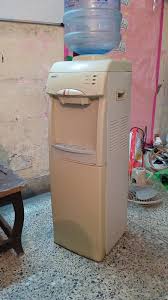
Checking a used Homage water dispensers & cooler
These are specific to Homage. The general water dispensers & coolers checks apply too and are on the water dispensers & coolers page.
Start it on utility mains
A compressor draws several times its running current for the instant it starts, so a unit demonstrated behind an inverter can hide a compressor that no longer starts cleanly. Plug it into mains, listen for the compressor to settle within a second or two, and watch that nothing trips.
Open the compressor terminal cover
The starter and overload protector sit under a clip-on cover at the compressor. Scorch marks, a current relay that rattles when shaken because its contacts have been arcing, or an overload that clicks the compressor off within a minute all point to repeated hard starts on a sagging supply.
Test it in afternoon heat
A tired compressor will start on a cool morning and stall in the afternoon, because a higher ambient temperature raises head pressure and with it the torque needed to start. Where the machine has been standing unused, run it during the hottest part of the day before deciding.
Inspect the plug and lead
Look for splices, taped joints or a replaced plug top on the lead, and for browning at the pins. A dispenser moved on to a backup socket often gets a lengthened or rewired lead, and heat marks at the pins mean a poor connection carrying a starting surge.
What Homage water dispensers & coolers are worth
- What fails most on these machines — starter, overload, thermostat, element, taps — are industry-standard items rather than badge-specific ones, so ordinary faults are put right without touching the dealer channel at all.
- A compressor that hard-starts is what caps the grade, because replacing a compressor and recharging a machine this size is work out of proportion to the machine it sits in.
- Evidence that a unit has only ever run on mains — an original plug top, a clean starter, no rework in the terminal box — supports the grade, since the compressor has not been asked to start behind a sagging supply.
General water dispensers & coolers checks
These apply whatever the badge on the front says — the water dispensers & coolers page covers them in full.
Check how it cools
A compressor dispenser cools the way a fridge does and will bring water to a properly cold drinking temperature; a thermoelectric one uses a solid-state plate and only takes the edge off. Look behind the cabinet for a small black cylinder and warm coils, then fill the tanks, switch the cold side on and come back after twenty minutes. Merely cool water after that long means lost gas or a failed plate.
Test the hot tank
With water in the tanks, switch the hot side on and wait around ten minutes; the indicator should cycle and the red tap should give water hot enough to steam. Nothing at all usually means a burnt element or a tripped cut-out, and a tank thick with scale gives a slow, spitting flow.
Look for crust and rust
Pull the drip tray and look underneath and at the rear panel below the taps. A white mineral bloom, rust streaks or a stained cabinet floor means a slow weep that has been running a while. On most dispensers the cold tank is foamed into the cabinet, so a seam leak means stripping the machine rather than tightening a joint.
Work every tap
Press each tap fully and release it. A tap that keeps dripping after release has a perished washer, which is cheap to put right but tells you how much use the unit has had. Check the tap bodies and levers for cracks, and on push-button models make sure the button springs back rather than sticking in.
Open the bottle seat
Inspect the seat and probe the bottle sits on for cracks and for a hardened, dirty seal, since that is where most contamination gets in. Open the storage or refrigerated compartment door, work the hinge and check the gasket; on a compressor model a compartment that never gets cold points at a blockage in the cooling circuit rather than a door problem.
Look inside a deck cooler
On a steel electric cooler, lift the lid and look at the coil and tank walls. Water in both cities is hard, and heavy scale on the coil slows cooling badly, though it can be scrubbed off. Rust blooming along the base seam of the outer cabinet is more serious than surface rust on the side panels, because the base is what carries the weight of a full tank.
Homage water dispensers & coolers — questions
Will a Homage water dispenser run on an inverter or UPS?
Is a used Homage dispenser worth buying?
Other water dispensers & coolers brands
Selling one instead? We buy used Homage water dispensers & coolers for cash.