
Used Gree water dispensers & coolers in Islamabad & Rawalpindi
Is a used Gree water dispensers & cooler worth buying?
Gree is an air-conditioning badge here. Its split units come through a national partner with assembly and service behind them; its dispensers do not, and arrive as imports beside a business built on ACs. So the question on a used Gree dispenser is not whether the brand is serviced in Pakistan, which it plainly is, but whether that particular model's parts exist in the same system.
Imported
Parts usually have to be imported or sourced from the grey market, so a repair takes longer and costs more — which matters more on an older unit than the build quality does.
Gree service in both cities runs through the brand's national partner and is organised around air conditioning, so dispenser fascias, taps and hot tanks are ordered rather than stocked. Standard refrigeration work — compressor, gas, drier, thermostat — is within reach of any competent independent technician, and that is the practical route for most faults.
Water Dispensers & Coolers in stock now
Our current water dispensers & coolers, across all brands — ask us on WhatsApp if you want Gree specifically.
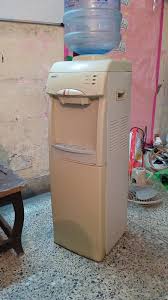
Checking a used Gree water dispensers & cooler
These are specific to Gree. The general water dispensers & coolers checks apply too and are on the water dispensers & coolers page.
Find the partner's service label
Officially imported Gree goods carry the national partner's sticker and a UAN, not just the Chinese factory plate. That label is the only thing connecting the unit to the organisation that could order a part for it.
Ring the UAN about parts
Ask a precise question: can you order parts for this dispenser model? 'We service Gree' is an answer about air conditioners. Do it with the model code from the plate in front of you, before any money changes hands.
Check the model is listed
Compare the model code on the plate against what the partner currently sells. Dispenser lines turn over faster than AC lines, and a model that has dropped off the list puts fascias, taps and hot tanks onto factory orders rather than shelf stock.
Ask what has been replaced
Find out whether past repairs used the partner's parts or local substitutes. Thermostats, tap valves and relays have workable local equivalents, so a unit already wearing them tells you the owner could not get originals — which is the position you are inheriting.
Confirm the cooling is conventional
A compressor, condenser coil and filter drier with a plain thermostat in the circuit means any independent fridge technician can do the routine work without involving the partner. A control board sitting between the thermostat and the compressor puts you back in that queue.
What Gree water dispensers & coolers are worth
- Documentation carries more weight here than on a locally made badge, because the partner's label and a currently listed model are what make a matched part orderable at all.
- The conventional sealed system is the saving grace: routine cooling work can be done outside the partner's network, so a Gree dispenser is not a dead end when that network is slow on dispenser parts.
- Cosmetic damage cannot be put right, since fascias, tap panels and drip trays for imported models have no local supply, and it therefore caps the grade permanently.
- The badge's recognition comes from air conditioning and brings no dispenser parts channel with it, so it is the buyer's phone call rather than the name that settles the price.
General water dispensers & coolers checks
These apply whatever the badge on the front says — the water dispensers & coolers page covers them in full.
Check how it cools
A compressor dispenser cools the way a fridge does and will bring water to a properly cold drinking temperature; a thermoelectric one uses a solid-state plate and only takes the edge off. Look behind the cabinet for a small black cylinder and warm coils, then fill the tanks, switch the cold side on and come back after twenty minutes. Merely cool water after that long means lost gas or a failed plate.
Test the hot tank
With water in the tanks, switch the hot side on and wait around ten minutes; the indicator should cycle and the red tap should give water hot enough to steam. Nothing at all usually means a burnt element or a tripped cut-out, and a tank thick with scale gives a slow, spitting flow.
Look for crust and rust
Pull the drip tray and look underneath and at the rear panel below the taps. A white mineral bloom, rust streaks or a stained cabinet floor means a slow weep that has been running a while. On most dispensers the cold tank is foamed into the cabinet, so a seam leak means stripping the machine rather than tightening a joint.
Work every tap
Press each tap fully and release it. A tap that keeps dripping after release has a perished washer, which is cheap to put right but tells you how much use the unit has had. Check the tap bodies and levers for cracks, and on push-button models make sure the button springs back rather than sticking in.
Open the bottle seat
Inspect the seat and probe the bottle sits on for cracks and for a hardened, dirty seal, since that is where most contamination gets in. Open the storage or refrigerated compartment door, work the hinge and check the gasket; on a compressor model a compartment that never gets cold points at a blockage in the cooling circuit rather than a door problem.
Look inside a deck cooler
On a steel electric cooler, lift the lid and look at the coil and tank walls. Water in both cities is hard, and heavy scale on the coil slows cooling badly, though it can be scrubbed off. Rust blooming along the base seam of the outer cabinet is more serious than surface rust on the side panels, because the base is what carries the weight of a full tank.
Gree water dispensers & coolers — questions
Is Gree water dispenser service available in Islamabad and Rawalpindi?
How do I know a used Gree dispenser was officially imported?
Other water dispensers & coolers brands
Selling one instead? We buy used Gree water dispensers & coolers for cash.