
Used Haier water dispensers & coolers in Islamabad & Rawalpindi
Is a used Haier water dispensers & cooler worth buying?
Two different Haiers circulate here. One comes through the local joint venture, carries the Pakistani company's name and a service number on the plate, and is recognised by the network. The other is China-market stock brought in by importers, with Chinese text on the panel and a model code the local system has never seen. Establish which one you are looking at first.
Mixed — partly assembled locally
Parts availability depends on the model line: locally assembled ranges are straightforward, imported ones less so. Worth confirming before you count on a repair.
For locally supplied Haiers the joint venture's channel covers both cities and orders matched parts — boards, fascias, hot tanks — against the serial, while taps, valves, thermostats and sealed-system work are routine for independent fridge technicians. A China-market unit sits outside that entirely, and every matched part becomes a personal import.
Water Dispensers & Coolers in stock now
Our current water dispensers & coolers, across all brands — ask us on WhatsApp if you want Haier specifically.
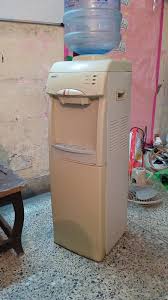
Checking a used Haier water dispensers & cooler
These are specific to Haier. The general water dispensers & coolers checks apply too and are on the water dispensers & coolers page.
Read the plate language
A locally supplied Haier names the Pakistani company and a service number in English or Urdu. A China-market unit carries Chinese text, a domestic model code and no local entity at all, and the network cannot open a job on something it has no record of.
Look for a stuck-on label
Grey-imported units are often relabelled: a printed sticker over the original panel text, mismatched fonts, or a warning label in one language and the rating plate in another. Lift a corner and see what is underneath before you accept the model code you were given.
Check how it is controlled
A knob thermostat is a commodity part any technician will substitute. A touch panel or a digital display means a control board matched to the model, which cannot be substituted and has to be ordered through whichever channel the unit originally came through.
Read the compressor label
Read the badge on the compressor itself, not on the cabinet. A make with no connection to the appliance means the sealed system has already been opened and rebuilt, and that repair is only ever as good as the vacuum pulled at the time.
Ask for the warranty card
Cover on these is registered against the serial and the original purchaser and is rarely transferable. Get the card and the invoice, and treat any remaining warranty as unproven until the service line has confirmed it against that serial.
What Haier water dispensers & coolers are worth
- Provenance sets the ceiling before condition does: a unit the local network recognises can be repaired through it, and a Chinese-labelled import cannot, however clean it is.
- Board-controlled models fall further when they fail than knob-controlled ones, because a matched board has to be ordered while a thermostat is a shelf part.
- A sealed system that has already been opened prices below one that has not, since a rebuilt circuit is only as good as the vacuum and charge it was given.
- Warranty that cannot transfer adds nothing to a used unit, so any asking price resting on remaining cover falls away once the serial is checked.
General water dispensers & coolers checks
These apply whatever the badge on the front says — the water dispensers & coolers page covers them in full.
Check how it cools
A compressor dispenser cools the way a fridge does and will bring water to a properly cold drinking temperature; a thermoelectric one uses a solid-state plate and only takes the edge off. Look behind the cabinet for a small black cylinder and warm coils, then fill the tanks, switch the cold side on and come back after twenty minutes. Merely cool water after that long means lost gas or a failed plate.
Test the hot tank
With water in the tanks, switch the hot side on and wait around ten minutes; the indicator should cycle and the red tap should give water hot enough to steam. Nothing at all usually means a burnt element or a tripped cut-out, and a tank thick with scale gives a slow, spitting flow.
Look for crust and rust
Pull the drip tray and look underneath and at the rear panel below the taps. A white mineral bloom, rust streaks or a stained cabinet floor means a slow weep that has been running a while. On most dispensers the cold tank is foamed into the cabinet, so a seam leak means stripping the machine rather than tightening a joint.
Work every tap
Press each tap fully and release it. A tap that keeps dripping after release has a perished washer, which is cheap to put right but tells you how much use the unit has had. Check the tap bodies and levers for cracks, and on push-button models make sure the button springs back rather than sticking in.
Open the bottle seat
Inspect the seat and probe the bottle sits on for cracks and for a hardened, dirty seal, since that is where most contamination gets in. Open the storage or refrigerated compartment door, work the hinge and check the gasket; on a compressor model a compartment that never gets cold points at a blockage in the cooling circuit rather than a door problem.
Look inside a deck cooler
On a steel electric cooler, lift the lid and look at the coil and tank walls. Water in both cities is hard, and heavy scale on the coil slows cooling badly, though it can be scrubbed off. Rust blooming along the base seam of the outer cabinet is more serious than surface rust on the side panels, because the base is what carries the weight of a full tank.
Haier water dispensers & coolers — questions
How do I tell whether a used Haier dispenser was sold locally or imported?
Does a Haier warranty transfer if I buy the dispenser second-hand?
Other water dispensers & coolers brands
Selling one instead? We buy used Haier water dispensers & coolers for cash.